

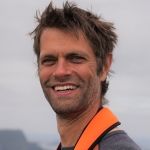
I am motivated by understanding how life on Earth works. With a background in ecophysiology and behavioural ecology, I now use evolutionary models to study adaptations for how organisms deal with their environments. I enjoy developing models that integrate physiology, behavioural ecology, and life history theory. These allow me to study the emergence of adaptations and ecological dynamics, suggesting possible niches. Below are some of the themes I am currently engaged in.
Where we live and work, at 60°N, seasons are pronounced and change from short days in winter to nights in summer that are so bright that one can read a newspaper at midnight. Another striking effect of light at high latitudes is that sunrise and sunset can take hours, in fact months at the pole itself. This has led me to appreciate that light is a strong driver for many ecological processes, and that even slow and gradual changes can have important effects.
The human eye is among the best in the world for bright daylight, but most animals live in the dark. We struggle on a moonless night, but some fishes see at levels 1000 times dimmer than that. Being day-active, we have little intuition for how animals cope at those light levels. In our group we develop computer models for light and vision that are valuable tools for studying behaviours and ecological interactions in dynamic light environments. We have also studied nighttime ecology at coral reefs.
Sometimes the results from light-driven models surprise us. For example, we have found that with climate warming, the role of pronounced seasons at high northern latitudes may shift species ranges southwards, contrary to the general expectations in climate research.
Sexual reproduction is widespread in nature, and I believe that some of its systemic effects are understudied. With sigrunn.eliassen@uib.no, I have studied how extra-pair mating in birds may incentivize males for cooperative behaviours that favour the neighbourhood. This is the type of mechanism that when you see how it works in one context, you begin to see fingerprints of it in many more species and places than have been studied.
Sustainability is the most important challenge of our time but often referred to as a wicked problem because everything is connected to everything and many opposing viewpoints may appear well-reasoned at the same time. In contrast to regular problems in science, context often matters enormously. One contribution we have made shows that international fisheries negotiations can result in rules with large emission consequences.
Together with a few colleagues, I have been arranging the Darwin Day in Bergen since 2006. In March 2026, Samir Okasha will visit Bergen to share his reflections on the role of Richard Dawkins’ The Selfish Gene, the book that was instrumental in changing how biologists think when it came out 50 years ago.
(+47) 41809327
Office:
3H18
Thormøhlensgate 53B
3rd floor
Postal Address:
Department of Biological Sciences
University of Bergen
P.O. Box 7803
N-5020 Bergen
Norway